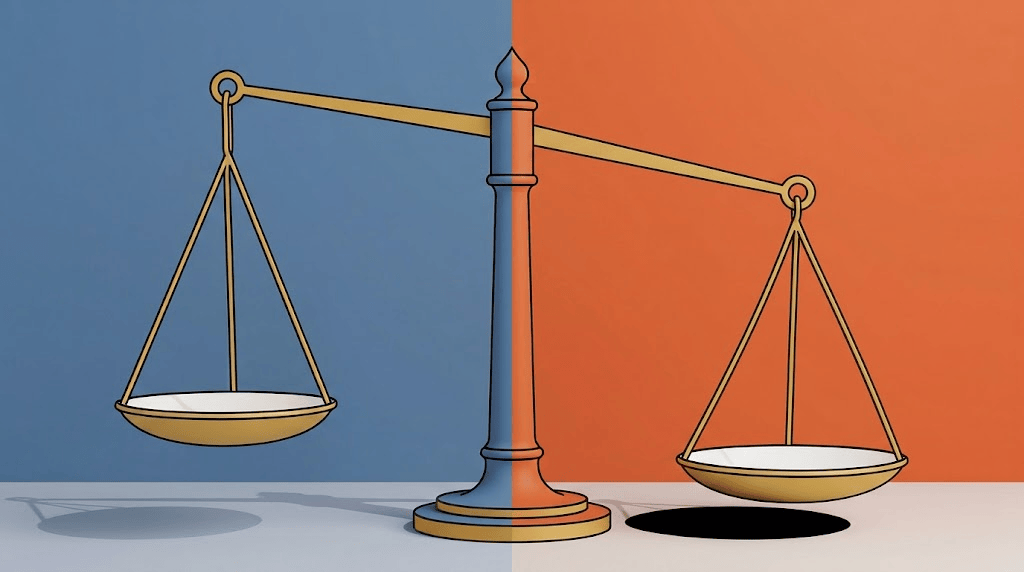
Criticize the Republican Party, and someone will almost always ask whether Democrats are any better. It’s a fair question. The honest answer is that it depends on what we’re measuring.
Some establishment politicians cozy up to corporations, protect their donors, and seem to enjoy the cameras more than the work. The House Democratic Leader Hakeem Jeffries, talks a lot about protecting vulnerable people, and on many domestic issues his voting record backs that up. But when a group of House Democrats voted to cut military aid to Israel, Jeffries opposed them, shortly after significant AIPAC-linked money flowed into his political operation. That’s a real case for replacing a lot of establishment Democrats.
Degrees matter
We understand that wrongs come in different sizes. Being late for work is not the same as not showing up for work. Somehow we lose that common sense when it comes to politics. Pointing to some established Democrats doesn’t erase what the Republican Party as a whole has become.
A weak politician is not the same as a national movement reorganizing the government around cruelty, concentrated executive power, religious nationalism, and loyalty to one man.
Democratic policies, however incomplete or compromised, generally try to expand healthcare, food security, labor protections, and education, and to support people who are struggling. That doesn’t make every Democrat good at the job. But today’s Republican Party is heading in a very different moral direction, one that increasingly treats suffering as deserved and mercy as weakness.
It’s possible to be frustrated with the cowardice, donor dependence, and hypocrisy of many establishment Democrats while also seeing the current moral condition of the Republican Party as something far more serious. Those two judgments don’t have to carry the same weight, and they shouldn’t.
So how do we fix it?
Collective action. It consistently beats individual action. People still have real power when we work together and communicate clearly. The message should be that big money and foreign influence can’t buy an election when people decide otherwise. This is when “I don’t do politics” has to give way to civic engagement. The price of your kid’s inhaler, the safety of your parents’ retirement, the school your children attend: all of it is decided by people you either help choose or let others choose for you.