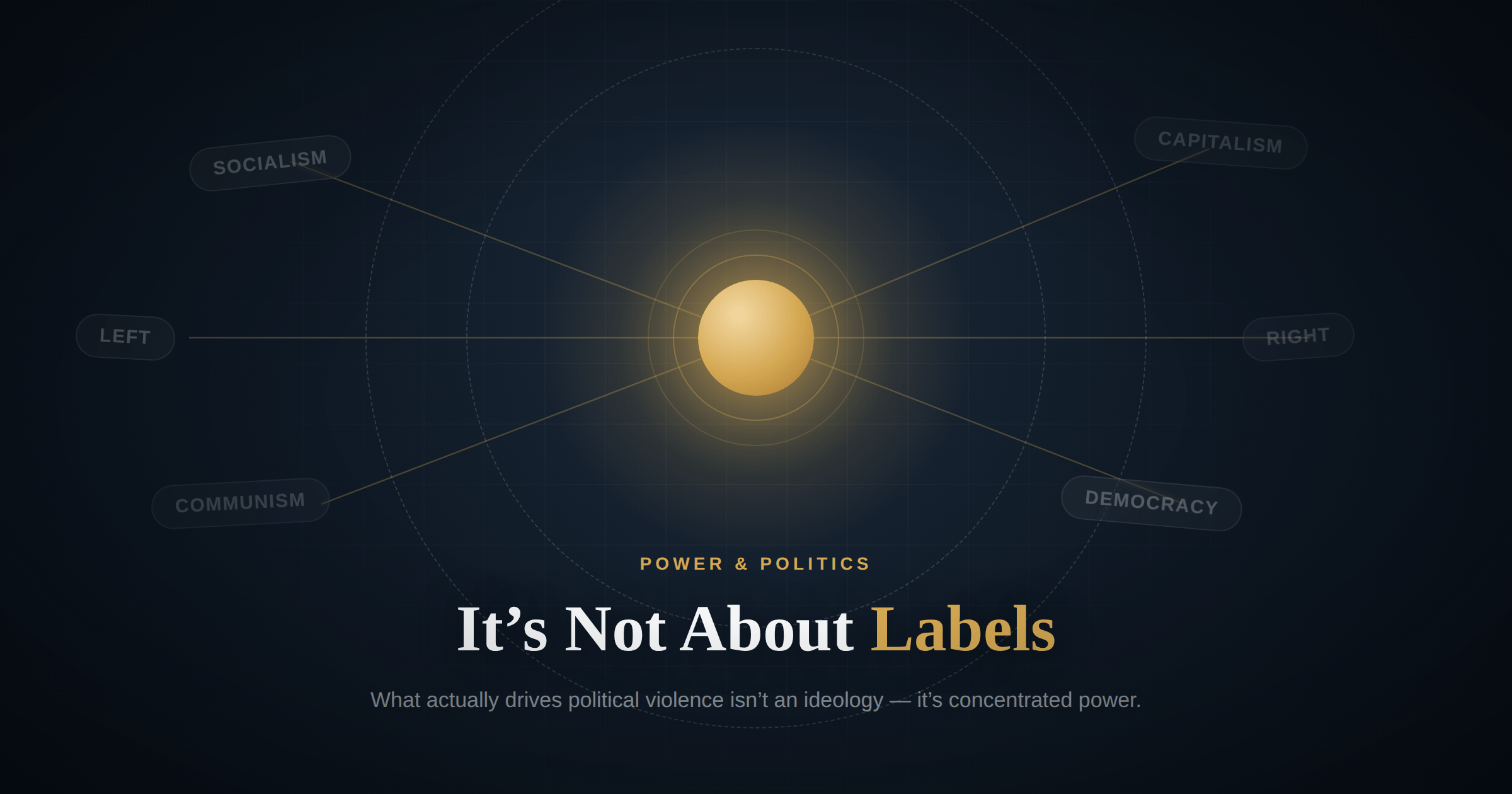
Every time a politician wins an election on policies outside the mainstream, the same argument breaks out. Critics reach for history’s worst regimes and say “this ideology killed millions of people.” Supporters fire back with their own list of atrocities committed under the opposite ideology. Both sides walk away more certain they were right, and nothing actually gets discussed.
That argument is missing the point.
The Real Pattern Behind Atrocities
Look closely at history’s worst and now current chapters that continue to be written, and the common thread isn’t a specific ideology. It’s concentrated power.
Stalin and Mao ruled in the name of communism. Hitler ruled in the name of fascism. Pol Pot, Genghis Khan, and Alexander the Great didn’t even share a modern political label, yet they left behind similar devastation.
The label on the system barely matters. What matters is what happens when power gets concentrated in too few hands, with too little accountability to everyone else. Once that gap between the powerful and the people grows large enough, the people in charge tend to stop seeing ordinary citizens as people. They start seeing them as tools, or obstacles, or acceptable losses on the way to some “greater good.”
Why This Matters for Today’s Politics
This is why arguments that boil down to “socialism bad” or “capitalism bad” miss the real danger. A policy backed by fair, democratic support isn’t inherently more dangerous just because of the label attached to it. What should actually worry people is when power gets concentrated enough, in few enough hands, that regular citizens can no longer hold it accountable.
A modern example is playing out in media itself: in 2026, the U.S. Department of Justice approved a roughly $110 billion deal, backed in large part by billionaire Larry Ellison, handing Paramount Skydance control of Warner Bros. Discovery. That single deal consolidates CBS, Paramount Pictures, CNN, HBO, and the Discovery networks under one family’s ownership. When the industry meant to hold power accountable becomes concentrated in a handful of hands itself, the normal checks citizens rely on get thinner.
A government using economic policy to punish the powerless is a warning sign. So is a small group of the powerful working to override what a democratic majority has already chosen, simply because they dislike the outcome. Both are symptoms of the same underlying problem: too much power, too little accountability, too much distance between decision-makers and the people affected by those decisions.
Judge the Outcome, Not the Label
None of this means every policy pitched under a popular label will work. Good intentions don’t guarantee good results, and execution matters as much as ideas do. But that’s exactly why the conversation should focus on whether power is being checked and whether people are being heard, not on which political label makes for the scarier headline.
The next time a political fight breaks out over “isms,” it’s worth asking a different question: who actually holds the power here, and who is being left out of the decision? That question tends to matter a lot more than any label ever will.