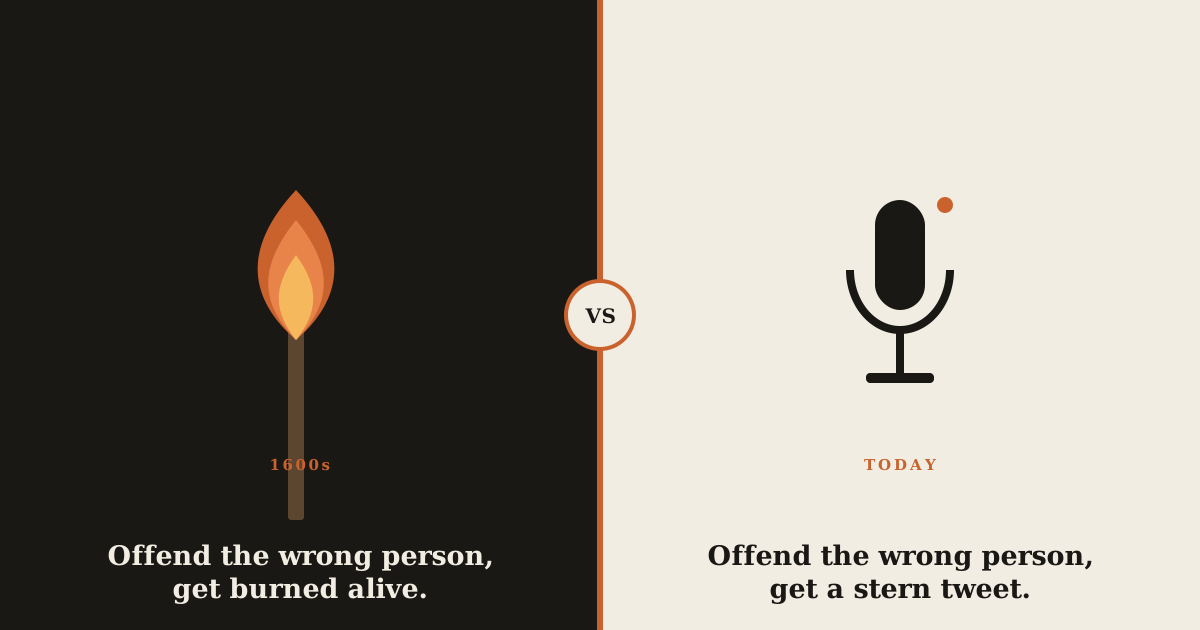
You’ve probably heard this complaint before: “Smart people have to stay quiet now so that dumb people don’t get offended.”
The idea behind it is that there used to be a time when you could say the truth and face no consequences. But that time never existed. There’s only ever been a shifting list of who gets punished for offending who.
History Says Otherwise
Here’s a quick tour of what actually happened to people who “offended” the wrong crowd:
- The witch trials (1300s–1700s): Historians estimate 40,000 to 60,000 people were executed as witches, about three-quarters of them women. Most of them hadn’t done anything except act a little more independent than people were comfortable with.
- Galileo (1600s): He showed evidence that the earth orbits the sun. For that, he was sentenced to life imprisonment, later reduced to house arrest for the rest of his life. The fact threatened the beliefs of people in power, and facts that threaten power are always treated as offensive by the people holding it.
- Alan Turing (1950s): Turing built the machine that cracked German codes in World War II — probably the single biggest individual contribution to winning the war, and also the foundation of modern computing. In the 1950s, he was chemically castrated for being gay. The treatment destroyed his health, ended his career, and contributed to his suicide at age 41. One of the greatest minds in history was cut down because his sexuality offended people.
- The Civil Rights Movement (1950s–60s): Black Americans were fighting just to be treated as equal under the law — access to restrooms, bus seats, and, more importantly, education and opportunity. Blocking that kind of mobility increases poverty. Poverty increases desperation. Desperation, combined with heavy policing, increases crime rates. Those crime rates were then used to justify the policing and the inequality that caused them in the first place. That cycle isn’t fully over.
This Isn’t Ancient History
None of this happened that long ago:
- The King of England was alive for all of it.
- The current U.S. president was alive for all of it.
Which makes “Make America Great Again” worth a simple follow-up question: again, when, exactly?
So, Which Era Do We Mean?
- The 1950s and 60s? Back when Jim Crow laws segregated basketball and other sports, and Black kids weren’t allowed to play with white kids. Imagine being offended by that.
- 1974? That’s the year the Equal Credit Opportunity Act finally gave American women the legal right to open a bank account or get credit without a father, husband, or male guardian’s permission. For context: an 18-year-old Donald Trump could open his own bank account before his own mother could open hers.
- The 1980s? When Reagan and Thatcher sold the idea that giving more wealth to the already-wealthy would somehow make everyone else rich. It didn’t — it kicked off a wealth gap that, by some measures, now rivals pre-revolution France, though economists disagree on exactly how the two eras compare.
- The era of neo-colonialism? When wealthy nations installed and backed genocidal dictators around the world.
- The War on Drugs? The War on Terror?
Pick one. Which era of “greatness” are we actually trying to bring back?
The Real Complaint
Watching what you say so you don’t upset people who don’t like being told they’re wrong isn’t new. It’s basically always been part of being human.
What’s strange is this: a lot of the loudest voices complaining that “you can’t say anything anymore” are also pushing to bring back the traditional values of a culture that used to burn people alive for saying the wrong thing. And many of them are making very comfortable livings saying the exact things they claim they’re no longer allowed to say.
Strip away the framing, and the complaint gets a lot simpler:
“It used to be easier for people like me. There’s less special treatment now. And that’s offensive.”